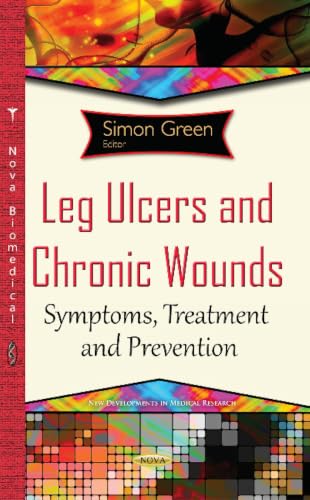
Leg ulcers and chronic wounds : symptoms, treatment and prevention / Simon Green, editor.
Material type: TextLanguage: English Series: New developments in medical researchPublication details: NY : Nova publishers, 2015.Description: xi, 182 pages : illustrations ; 24 cmISBN:
 - 9781634834766
- 1634834763
- 617.5/84044 23
- RC951 .L38 2015
- WE 850
| Item type | Current library | Call number | Status | Date due | Barcode | |
|---|---|---|---|---|---|---|
 წიგნი
წიგნი
|
უცხოური ლიტერატურის სამკითხველო დარბაზი უცხოური წიგნების სამკითხველო დარბაზი | 617.3 L-49 (Browse shelf(Opens below)) | Available | 10117 |
Includes bibliographical references and index.
Chapter 1. Leg ulcers and chronic wounds: innovative healing methods -- Chapter 2. Hard-to-heal venous leg ulcers: prognostic factors and therapeutic strategies -- Chapter 3. Drugs that interfere in the healing process of leg ulcers -- Chapter 4. Papain-based gel for the treatment of leg ulcers -- Chapter 5. Ultrasound as therapy for leg ulcer treatment -- Chapter 6. Compression therapy for varicose ulcers by using the unna boot and elastic bandages -- Chapter 7. Antiseptics used in the therapeutic management of the leg chronic wounds -- Chapter 8. Platelet-rich plasma (Prp) in treating chronic wounds, a current view -- Chapter 9. Modulating the foreign body response to treat chronic wounds.
A leg ulceration is a common, chronic, reoccurring condition. The majority of leg ulcers are due to venous and/or arterial disease. In this book, the future trends in the management of leg ulcers are discussed. The prognostic factors and risk factors are examined as well. Other chapters present a review on the impact of drugs commonly prescribed in clinical practices, and discuss their beneficial or detrimental role in chronic leg ulcers; a papain-based gel for the treatment of leg ulcers (papain is known for treating wounds of various etiologies and in several healing stages); compression therapy and ultrasound as therapy for leg ulcer treatment; an examination of the main antibiotics and antiseptics that are available for the therapeutic management of chronic leg ulcers, chronic wounds and the limitations of their use; and finally, the chapter provides the readers with a modulation of the foreign body response to treat chronic wounds.--
There are no comments on this title.